
If you are a UK fashion brand considering sourcing clothing from Bangladesh for the first time, 2026 is the strongest entry point the market has offered in a decade. The trade, compliance, and production conditions now favour UK buyers in ways that did not exist three years ago.
Why 2026 changes the sourcing equation
Three things shifted at once.
First, Bangladesh overtook China in US apparel exports during January and February 2026. That is not a UK statistic, but it signals where global production capacity is moving. Factories that previously ran at full capacity on US orders now have open lines, and UK brands benefit from that availability.
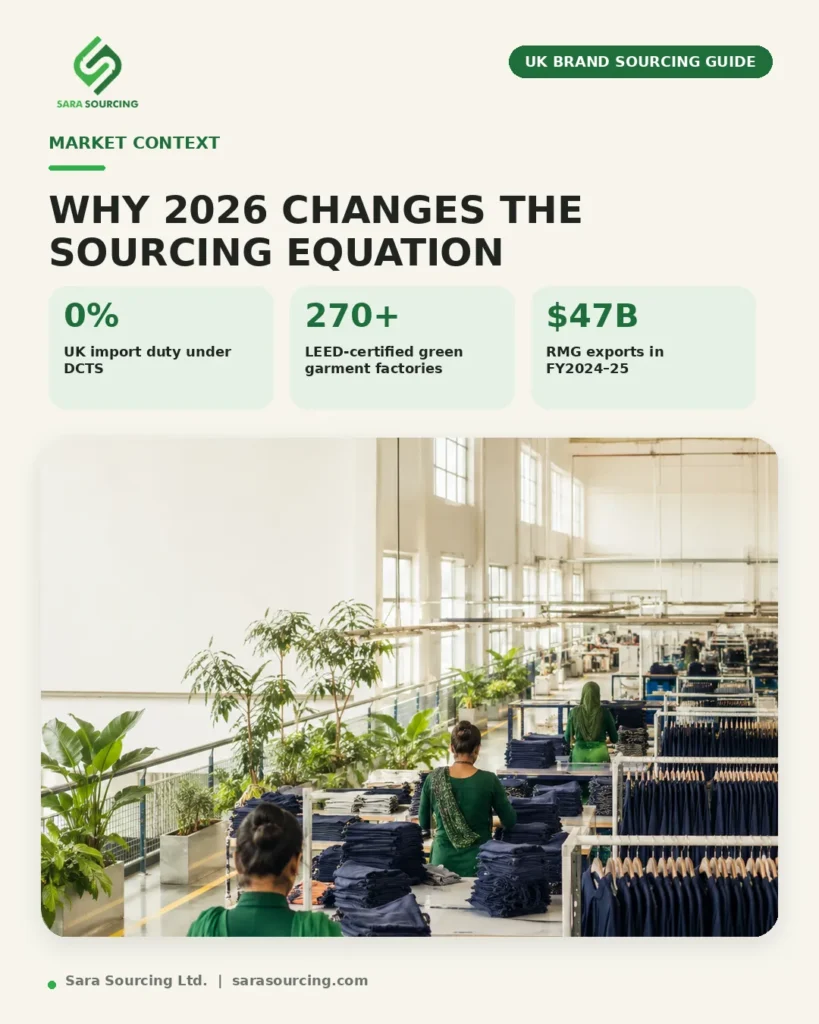
Second, garments manufactured in Bangladesh enter the UK at 0% import duty under the Developing Countries Trading Scheme (DCTS). Bangladesh graduates from Least Developed Country status on 24 November 2026, but the UK has confirmed that Enhanced Preferences will continue, maintaining duty-free access on apparel. For UK brands, this means no tariff disruption on the horizon.
Third, Bangladesh now has over 270 LEED-certified green garment factories, including more than 114 Platinum-rated facilities. No other country has that density of certified sustainable garment manufacturing. If your brand reports on supply chain sustainability, this matters.
The country shipped roughly $47 billion in ready-made garments during FY2024-25 and remains the world’s second-largest apparel exporter. The scale is there. Whether your specific product fits the capability is a separate question, and one worth answering before you contact a single factory.
What to prepare before sourcing clothing from Bangladesh
Most first-order delays happen before production starts. They happen because the brand was not ready.
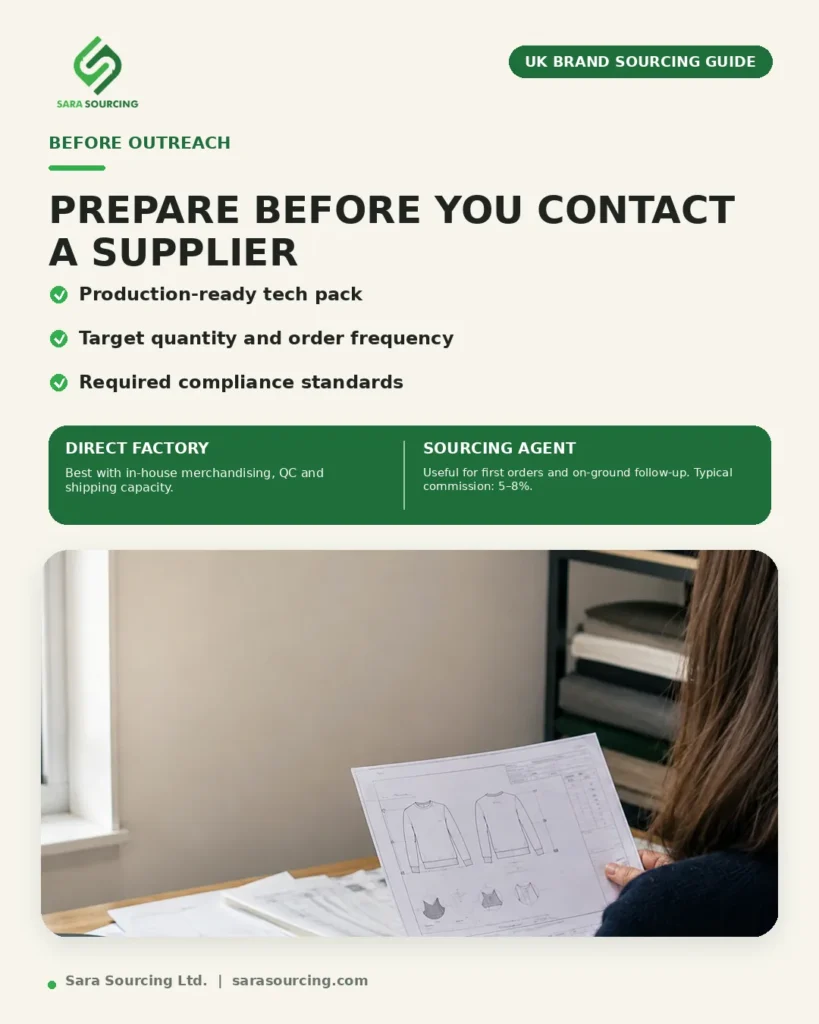
Before you reach out to any factory or sourcing agent, prepare three things.
A production-ready tech pack
Not a sketch with fabric swatches attached. A tech pack that a pattern maker can work from without sending questions back. That means construction callouts, a complete size spec table with points of measurement and tolerances, trim specifications with supplier references where available, Pantone colour references (TCX for textiles), and artwork placement with coordinates. If any of these are missing, expect at least one extra week in sampling.
Your target quantity and order frequency.
Factories price differently at 300 pieces, 1,000 pieces, and 5,000 pieces. A standard MOQ in Bangladesh ranges from 300 to 5,000 pieces per style, depending on the factory and the fabric. Custom-dyed fabric raises the minimum. Stock fabric lowers it. Know your numbers before you ask for a quote, because the answer changes everything about which factory fits.
Your compliance requirements
Most UK-supplying factories in Bangladesh hold BSCI, WRAP, or SEDEX certifications. If your retail partner requires a specific audit standard, confirm it early. Bangladesh was the first Asian country to adopt all ten fundamental ILO conventions and has the highest average number of social audits among SLCP-active countries. The compliance infrastructure exists, but you need to specify what you need.
Direct factory or sourcing agent?
This is the first real decision, and most guides skip the honest version.
Going direct to a factory works when you have in-house merchandising experience, your order volume is large enough to justify the factory’s time, and you can manage quality control, sampling follow-up, and shipping documentation yourself. In practice, that means you have done this before.
A sourcing agent works when you are placing your first or second order, your team does not have someone who speaks the production language fluently, or you need someone on the ground managing sampling, inline inspections, and shipment. A good agent manages factory selection, sample development, QC, and export documentation. The commission is typically 5-8% on top of the factory FOB price.
Some sourcing companies also own their manufacturing facilities. This can reduce the gap between what the agent promises and what the factory delivers, because the incentives are aligned under one roof.
Neither route is universally better. The right choice depends on your internal capacity and how much of the sourcing clothing from Bangladesh process you can manage in-house.
What clothing from Bangladesh actually costs
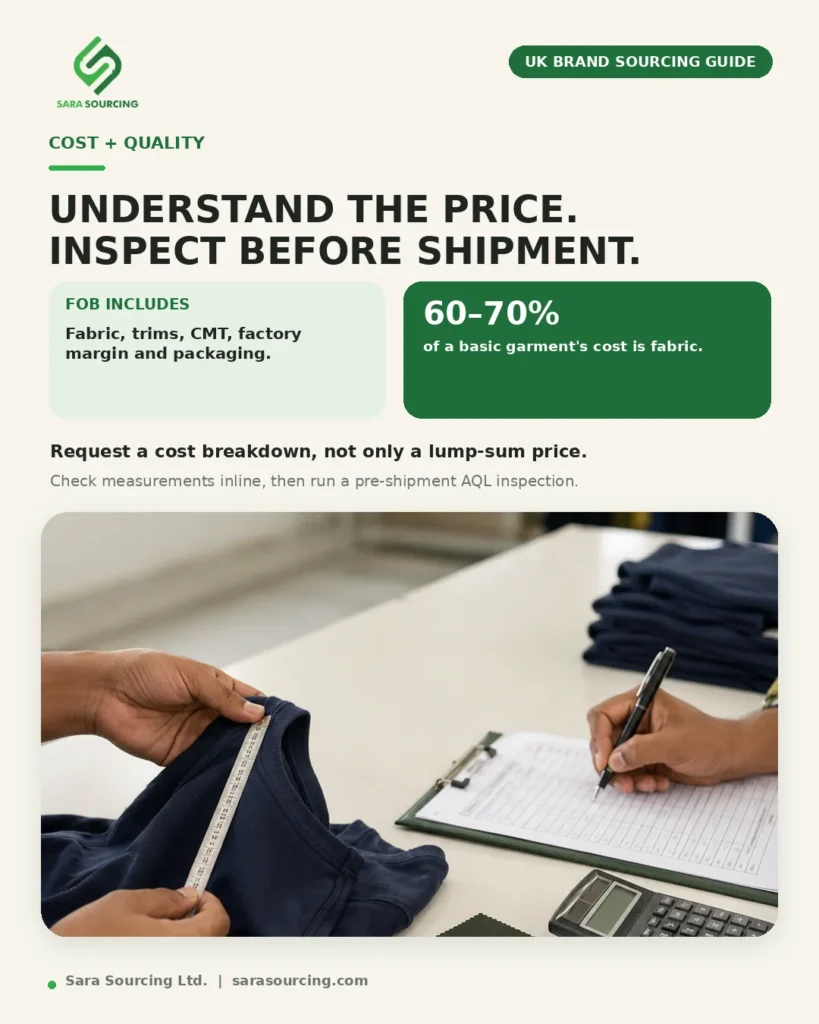
Pricing is FOB (Free on Board), which covers fabric, trims, cut-make-trim (CMT), factory margin, and packaging. It does not include freight, insurance, or UK import handling.
As a rough range for 2026, a basic 180 GSM cotton T-shirt at 5,000 units runs $2.80 to $3.50 FOB. A mid-range printed top with construction details runs $4.00 to $6.50. Complex styles with multiple trims, washes, or technical finishes push higher.
Fabric accounts for 60 to 70% of a basic garment’s cost. Construction complexity is the second largest factor. Two garments can look identical on a hanger and cost completely differently, because the difference is in the seam type, the number of operations, and the finishing method.
Always request a cost breakdown, not just a lump-sum price. Understanding the cost structure is one of the most important parts of sourcing clothing from Bangladesh. If a factory cannot explain where the price comes from, you cannot evaluate whether it is reasonable.
Quality control before shipment
Do not rely on the factory’s own QC alone. Most quality failures that reach UK warehouses were avoidable with one additional step.
At minimum, plan for a pre-shipment inspection based on AQL (Acceptable Quality Limit) sampling, which follows ISO 2859-1. Defects are classified as Critical (safety risk, automatic rejection), Major (unsellable, functional failure), and Minor (cosmetic, not visible at arm’s length). Set your AQL levels in writing before production starts, not after problems appear.
Check fabric quality and measurements at the inline stage, not only at final inspection. A measurement issue caught during sewing is a five-minute fix. The same issue caught at final inspection is a full rework.
If you are working with a sourcing agent, confirm that they conduct both inline and final inspections. If you are going direct, hire a third-party inspection service. The cost of an inspection is a fraction of the cost of rejecting a shipment.
Common mistakes when sourcing clothing from Bangladesh for the first time
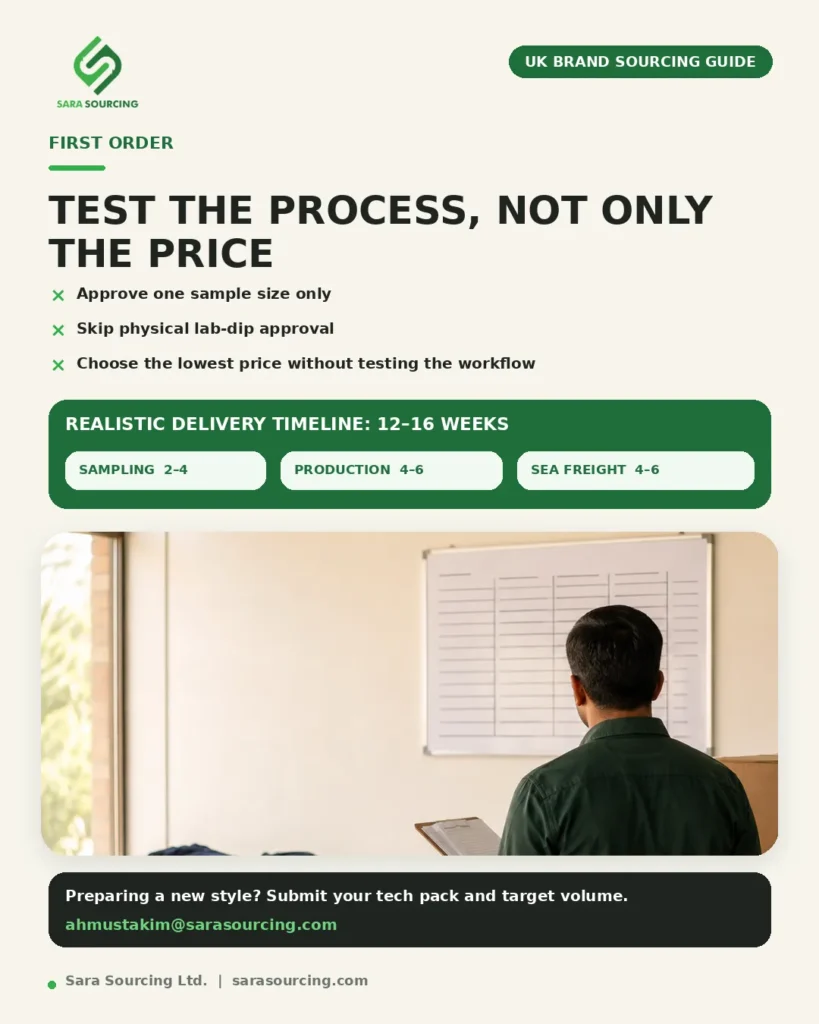
Approving a pattern from one sample size only. A fit that works on Medium can lose its proportions at XS and XXL. Request a size set before bulk approval, or at minimum check the grade rules.
Skipping the lab-dip approval on colour. Names like “dusty rose” or “stone wash” are not production standards. Lock Pantone references, approve physical lab dips, and confirm in writing before production starts. One person should own colour approval. If three people comment on colour across email, WhatsApp, and a marked-up PDF, the factory receives three different directions.
Treating the first order as a test of price rather than a test of process. The first order establishes whether your tech pack, communication, and approval workflow can sustain a production relationship. If you squeeze the first order on price alone, you are testing the wrong thing.
Frequently asked questions
Is Bangladesh only suitable for basic T-shirts and knitwear?
No. Bangladesh’s strongest category is knit garments (T-shirts, polos, jersey tops, activewear), but the woven sector has grown significantly. Denim, casual bottoms, and structured outerwear are produced at scale. For highly technical wovens or tailored suiting, other origins may be a better fit. Knowing what fits and what does not is part of sourcing clothing from Bangladesh well.
Will Bangladesh lose UK duty-free access after LDC graduation?
Not immediately. The UK has confirmed continued duty-free access under DCTS Enhanced Preferences after Bangladesh graduates from LDC status on 24 November 2026, with a transition period of at least three years. Rules of origin requirements may become more stringent, so confirm the latest terms before placing orders that span the graduation date.
What is a realistic timeline from tech pack to delivery?
For a new style with no prior relationship, allow 12 to 16 weeks from tech pack submission to delivery. That typically breaks down as 2 to 4 weeks for sampling and approvals, 4 to 6 weeks for production, and 4 to 6 weeks for sea freight to the UK. The largest variable is how quickly approvals move on the buyer side, not the factory side.
How do I verify a factory’s compliance and certifications?
Ask for current audit reports from recognised bodies (BSCI, WRAP, SEDEX, or amfori). Cross-check with the RSC (RMG Sustainability Council) database for structural and fire safety. A factory that cannot produce a current audit report is not necessarily non-compliant, but you will need to commission your own audit before placing an order.
At Sara Sourcing, our merchandising and technical teams review product briefs before development begins. If you are preparing a new style for production in Bangladesh, submit your tech pack and target volume for a readiness review at ahmustakim@sarasourcing.com.
#ApparelSourcing #BangladeshManufacturing #UKFashionBrands #GarmentSourcing #DCTS