
Final inspection in apparel production is often treated as the safety net of quality control.
It is not. It is the last chance to catch what the process already missed.
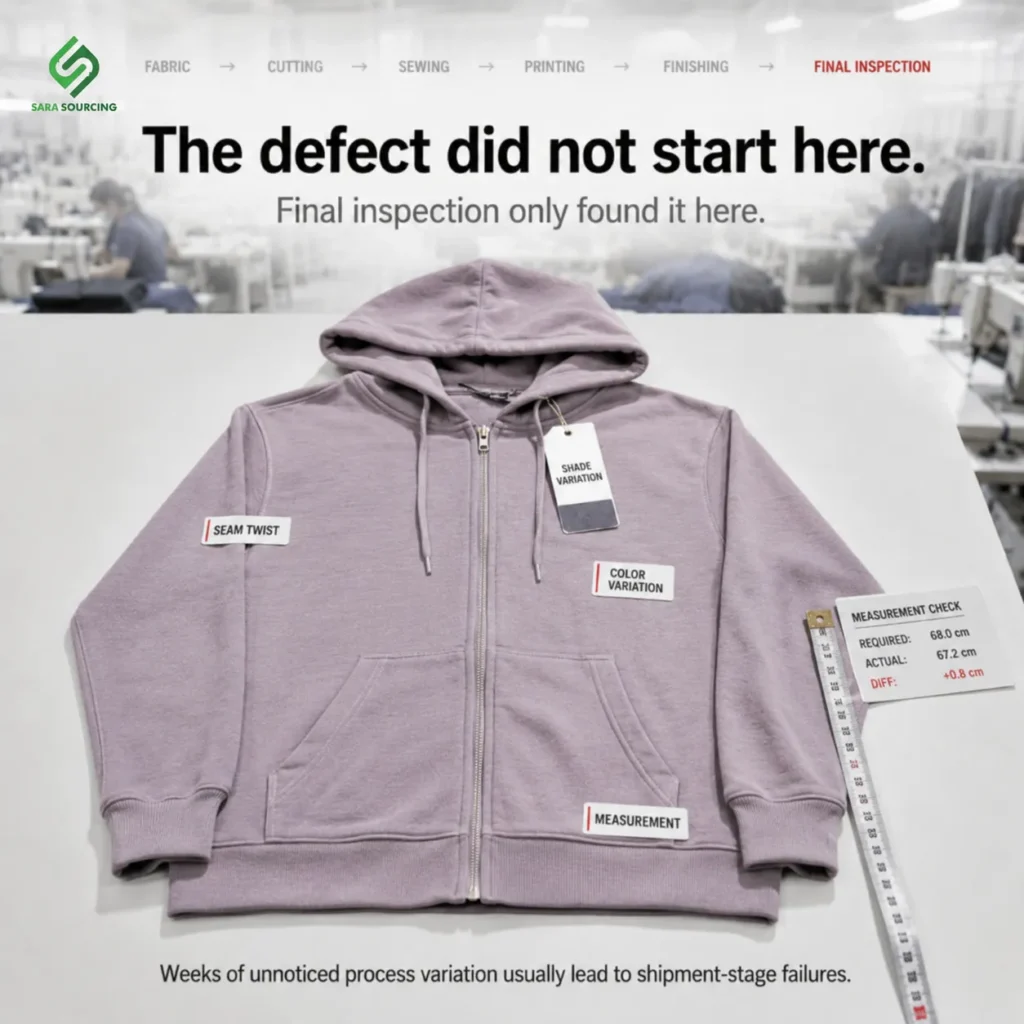
The shipment is packed. Deadlines are close. And most of the problems sitting inside those cartons did not appear overnight.
Quality Problems Usually Build Gradually
In apparel manufacturing, defects rarely come from one dramatic mistake.
They build quietly. A fabric issue missed at the incoming stage. Shrinkage results that never fed back into the cutting room. A measurement deviation that repeated across hundreds of units before anyone flagged it. A printing defect ignored mid-production because the line was already behind.
None of these feel catastrophic at the moment.
At shipment stage, they often are.
Final Inspection Often Reveals Problems That Started Weeks Earlier
Many apparel sourcing teams know this situation well.
The order looks stable. Shipment planning is already in motion. Then the final inspection report comes back with measurement failures, workmanship defects, shade variation, missing trims, packing inconsistencies.
At this stage, neither the factory nor the buyer has good options:
- Rework the goods
- Delay shipment
- Negotiate a discount
- Accept the shipment with risk
- Cancel or partially reject the order
For prepaid orders, this creates direct financial exposure. For non-prepaid orders, it still means delayed collections, operational disruption and pressure nobody planned for.
The problem is not only the defect. It is finding it at the worst possible moment.
Strong Garment Quality Control Starts Long Before Final Inspection
Experienced sourcing and quality teams do not wait for final inspection to understand what happened during production.
Before the line starts, materials are confirmed, trims are approved, specs are aligned. Not assumed. Confirmed.
From there, garment quality control checkpoints continue throughout production:
- Pre-Production Inspection (PPI)
- During Production Inspection (DuPro)
- Inline Quality Checks
- Final Random Inspection (FRI)
- Supplier Evaluation and Scorecards
- CAPA follow-up
This is not a checklist exercise. Each stage is a chance to catch something before it multiplies.
Inline Visibility Changes Everything
What separates well-controlled production from reactive production is not the final inspection report. It is what gets tracked and acted on in the middle.
Strong factories monitor defect frequency by line and operator, measurement consistency across cutting lots, rework volumes building up on the floor, and process variation before it becomes a pattern.
When that data exists and people act on it, a measurement issue stays manageable.
When it does not, the same issue quietly spreads across thousands of garments. By the time apparel final inspection catches it, the cost is no longer a quality problem. It is a business problem.
Supplier Quality Management Is Not Reset After Every Shipment
Passing one inspection does not make a supplier reliable.
What actually builds reliability is tracking what goes wrong, following up on corrective actions, and checking whether the fix held on the next order.
Most of the time, it did not. Different season, same root cause. Different style, same operator mistake. Different fabric, same incoming gap.
Factories that improve do so because someone kept records, asked hard questions and followed through. Not because the last shipment passed.
Final Inspection Should Be a Confirmation, Not a Strategy
Final inspection in apparel production still matters. But it works best when the production process has already been controlled properly from the beginning.
The strongest sourcing operations do not wait until shipment stage to understand product quality. They monitor step by step, identify problems early and reduce risk before it reaches the customer.
Because in apparel manufacturing, quality is rarely decided at the very end.
It is decided throughout the process, long before final inspection even begins.
If your quality system starts at final inspection, it is already starting too late.
Related posts:
Bangladesh vs China: Which Is the Smarter Garment Sourcing Destination in 2026?
How to Choose the Right Apparel Supplier for Your Brand: The 2026 Ultimate Guide
How Fabric GSM, Shrinkage, and Consumption Quietly Destroy Your Profit Margins