
Most production problems in clothing manufacturing start before the first stitch. In many cases, the issue is not the factory. It is the tech pack for clothing manufacturing. When a production-ready tech pack is missing details, unclear, or incomplete, factories are forced to make assumptions during sampling and bulk production.
By the time a brand notices something is wrong, like a misfit sample, incorrect seam construction, or trims that do not match, production decisions have already been made based on incomplete information.
Those gaps become production errors. And those errors lead to delays, correction costs, wasted samples, and sometimes unusable bulk inventory.
The Gap Nobody Talks About
A design sketch tells a story. A tech pack for clothing manufacturing gives instructions.
Factories do not manufacture from stories. They manufacture from specifications: measurements, tolerances, stitch types, fabric references, trim details, and grading rules.
When those specifications are missing or unclear, factories fill the gaps themselves. They make reasonable assumptions. And those assumptions, multiplied across hundreds or thousands of units, become the errors found at final inspection.
Factories often interpret incomplete specifications differently. What seems obvious to a designer is not always obvious to a production team working in a different language, a different context, and under time pressure.
Factories can only produce what the tech pack communicates clearly.
What Is Actually Missing in Most Tech Packs for Clothing Manufacturing
After reviewing production files across multiple brands, the same problems come up.
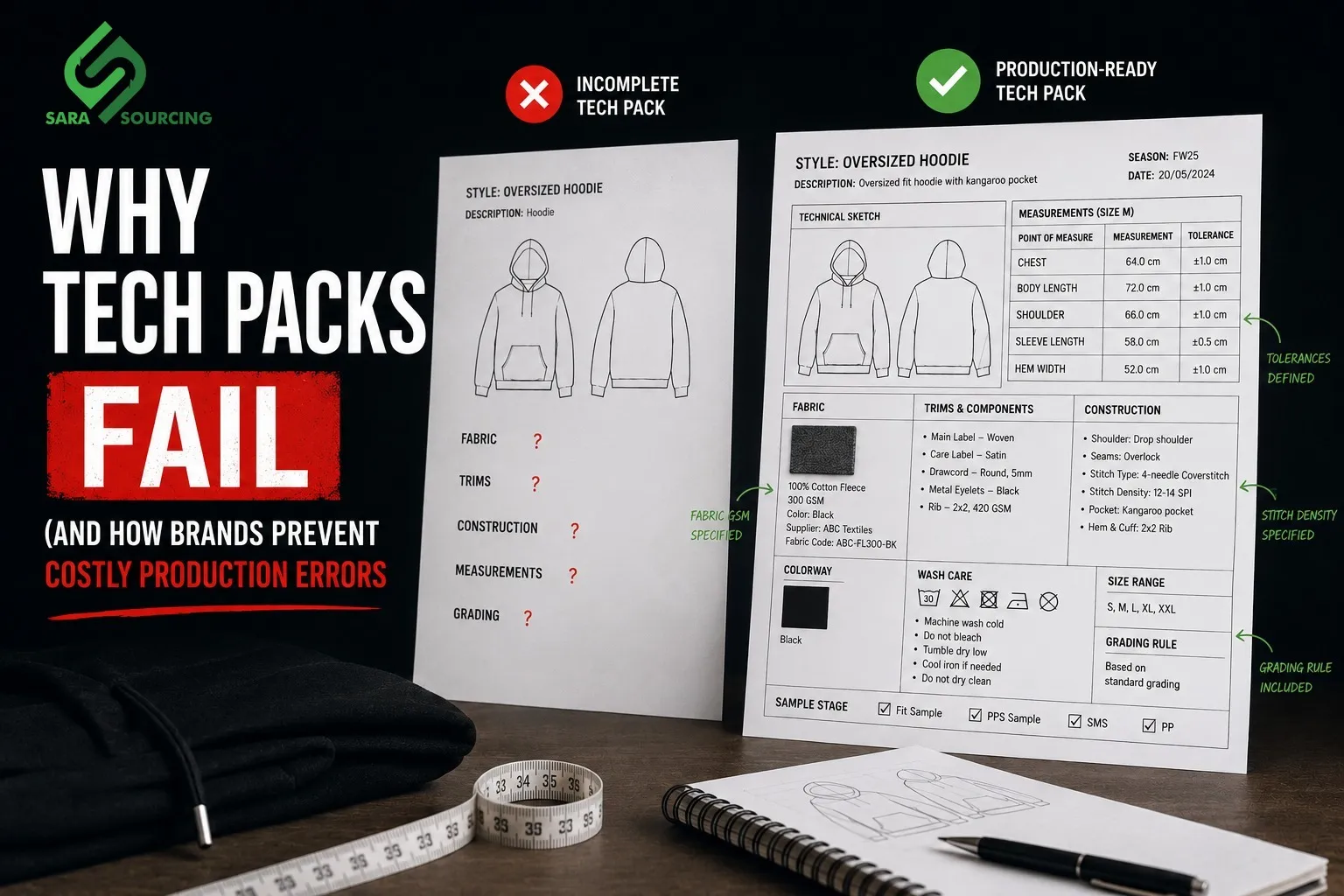
The most common is measurements without tolerances. A spec sheet with finished garment measurements is a starting point, not a complete instruction. Without defined tolerances, a factory does not know how much variation is acceptable during the fit approval stage. What passes QC in one batch may fail in another.
Closely behind that is no shrinkage consideration. Fabric behaves differently once it has been cut, sewn, washed, and finished. A proper wash test during development should inform the shrinkage allowances built into the spec sheet. Without it, the garment that passes sampling may not match what the customer receives after the first wash.
Construction details are another consistent gap. Seam type, stitch density, finishing method. These affect how a garment holds together and how long it lasts. Leaving them undefined means the factory decides. Sometimes they decide correctly. Sometimes they do not.
A vague Bill of Materials causes sourcing delays that brands rarely anticipate. If the BOM lists a zipper without a grade, reference, or supplier code, sourcing becomes a guessing game. Bulk production exposes specification gaps very quickly. What worked during sampling, when a factory could pause and ask questions, becomes a serious delay when production is already running.
Finally, missing or inconsistent grading creates size inconsistencies that surface as customer returns. It usually starts with a grading table that was not properly built or was not included at all.
Why Startups Struggle With Tech Pack for Clothing Manufacturing
Many startup brands invest heavily in design and branding. Technical preparation gets less attention, sometimes because they do not know what is needed and sometimes because they assume the factory will figure it out.
Experienced factories can work around some gaps. But they cannot manufacture what has not been specified. And they should not have to.
The real cost shows up in the timeline. Repeated sample corrections. A second fit approval round. A PPS sample that comes back with the same issue that was flagged in the first sample because the correction was never properly documented in the tech pack for clothing manufacturing. Weeks pass. Lead times extend. And by the time bulk production runs, the development budget has already been consumed fixing problems that a complete tech pack would have prevented.
Technical preparation protects both product quality and profit margins. It is also one of the areas where brands consistently underinvest until they have experienced the cost of not doing it.
What a Production-Ready Tech Pack Actually Looks Like
A production-ready tech pack removes ambiguity from every stage of manufacturing: sourcing, sampling, cutting, stitching, finishing, and quality control.
It starts with technical flat sketches, front and back garment views with enough construction detail that a factory pattern maker can work from them without needing to ask questions. Not design sketches. Production drawings.
The measurement spec sheet covers garment measurements for every size, with tolerances clearly defined and grading rules that produce consistent sizing across the full size range.
Fabric and trim details go beyond GSM and composition. Color references, supplier codes, a complete component list covering labels, zippers, buttons, drawcords, and packaging. A factory should never need to guess what a trim looks like.
Construction instructions specify seam type, stitch density, and finishing method. Vague instructions here are where seam puckering and finishing inconsistencies tend to appear, problems that are easy to prevent and time-consuming to fix after bulk approval.
Factories move faster when specifications are clear. A complete production-ready tech pack gives them exactly that and removes the interpretation gaps that slow everything down.
Artwork placement, grading, and packaging specs complete the document. A factory receiving all of this can move through sampling and into bulk with confidence. A factory receiving gaps will still produce, but the results are harder to predict.
Sampling Delays in Clothing Manufacturing: Where Gaps Show
Sampling is where specification gaps become visible.
When a first sample comes back with fitting issues, the instinct is often to blame the factory. Sometimes that is fair. But more often, the sample reflects exactly what was in the tech pack, which was not enough.
A second sample costs money and time. A third costs more. By the time a brand reaches a clean fit approval and moves toward PPS sample sign-off, weeks or months may have passed, and the development cost has grown well beyond what was planned.
Most production delays do not start on the factory floor.
Understanding how the garment sampling process works and what documentation it requires at each stage is one of the most practical things a brand can do before going into production. A second technical review before sampling often prevents expensive corrections later.
How Sara Sourcing Works With Brands at This Stage
At Sara Sourcing, the work happens before sampling starts, not after something goes wrong.
In practice, that means sitting with the tech pack and reviewing it the way a factory will. Identifying where measurements are incomplete. Checking that trim references are specific enough to source accurately. Looking at construction instructions and asking whether a factory in a different country could follow them without interpretation. Flagging any grading inconsistencies before they reach bulk.
During sampling, we evaluate against the tech pack criteria, not just visual impression. If a fit approval is borderline, we go back to the spec sheet to check whether the issue is a production error or a specification gap. Those are different problems with different solutions.
The goal is fewer surprises during production, fewer correction rounds, and a cleaner path from approved sample to shipped order. Brands that work this way spend less time managing problems and more time preparing for the next collection.
Brands serious about lead time management also benefit from this approach. Tighter specs at the development stage directly reduce the time lost to back-and-forth during sampling.
Final Thought
A tech pack for clothing manufacturing is not a formality. It is the primary communication between a brand and the people manufacturing its product.
If that communication is vague, the factory will interpret it. If it is inconsistent, the factory will choose. If it is incomplete, the results will reflect what was missing, not what was intended.
The clearer the technical communication, the smoother the production process becomes.
If you are preparing for a new production run, a second technical review before sampling often prevents expensive corrections later.
Related Articles
How to Source Knitwear from Bangladesh: A Complete Guide for UK Brands
Apparel Sourcing Bangladesh: Beyond Cost to Strategic Value
The Importance of Product Development in Apparel Manufacturing