
For decades, China has been the dominant force in global apparel manufacturing. It built its reputation on speed, infrastructure, and large-scale production capabilities.
But the sourcing landscape in 2026 looks very different.
Rising production costs, shifting global trade dynamics, and increasing pressure on brands to stay agile have forced fashion companies, especially in the UK, to rethink their sourcing strategies.
Today, the conversation is no longer about choosing the biggest manufacturing hub. It’s about choosing the smartest one.
And increasingly, that conversation includes Bangladesh.
Understanding the Core Difference
China and Bangladesh are not direct replacements for each other. They serve different strategic purposes.
China has evolved into a high-value manufacturing hub. It focuses more on automation, technology-driven production, and complex product categories.
Bangladesh, on the other hand, has built deep specialization in apparel manufacturing. Its entire ecosystem,from fabric sourcing to production lines,is optimized specifically for garments.
This difference is important. Because for most fashion brands, apparel is not a side category. It’s the core business.
Cost Efficiency: The Real Driver Behind the Shift
One of the biggest reasons brands are moving away from China is cost.
Over the past decade, labor costs in China have increased significantly. Operational expenses, compliance costs, and overheads have all risen. While China still delivers value in certain segments, it is no longer the low-cost option it once was.
Bangladesh offers a more cost-efficient alternative.
However, smart brands are not just chasing the lowest price. They are looking for cost efficiency with consistency.
That means:
- Stable pricing
- Predictable production costs
- Minimal wastage
- Reliable output
At Sara Sourcing, the approach is not about being the cheapest supplier. It’s about delivering the best possible value by combining competitive pricing with strict quality control and supplier management
This balance is what makes Bangladesh attractive for both emerging and established brands.
Production Capacity: Scale Meets Specialization
China is known for its industrial strength. It can handle massive production volumes across multiple industries.
But when it comes to apparel, Bangladesh has developed something equally powerful,a focused scale.
The country is one of the largest garment exporters in the world, with factories designed specifically for:
- Knitwear
- Woven garments
- Basic and fashion apparel
Modern manufacturing setups like Daylight Apparel Ltd. show how this capacity is structured.
With dedicated production lines and flexible manufacturing systems, brands can:
- Produce high-volume orders efficiently
- Run smaller batches for testing collections
- Scale production as demand grows
This flexibility is critical in today’s market, where brands need to balance bulk production with fast-moving trends.
Speed to Market: Why Time Matters More Than Ever
Speed is no longer just about how fast a factory can produce garments. It’s about how quickly the entire supply chain can move.
From design approval to final shipment, delays can cost brands valuable market opportunities.
China still has strong infrastructure advantages. But Bangladesh has significantly improved its speed by adopting smarter processes.
Many manufacturers now use:
- Faster sampling workflows
- Better production planning
- Integrated sourcing systems
This reduces lead times and improves overall efficiency.
In fact, with the right sourcing partner, brands can streamline the entire process, from initial inquiry to final delivery, without unnecessary delays.
Quality Control: Closing the Perception Gap
There was a time when China was considered the gold standard for quality in garment manufacturing.
That perception is changing.
Bangladesh has invested heavily in improving quality systems and compliance standards.
Today, many factories operate with:
- Structured quality control frameworks
- In-line inspection processes
- Final shipment checks
- Laboratory testing for fabrics and trims
At Sara Sourcing, quality is not treated as a final checkpoint. It is managed throughout the entire production cycle, including:
- Raw material inspection
- In-process quality monitoring
- Pre-shipment verification
This systematic approach ensures consistency and reduces the risk of defects.
Compliance and Ethical Manufacturing
For UK and EU brands, compliance is no longer optional. It is a requirement.
Consumers expect transparency. Regulators demand accountability. Retailers need to ensure that their supply chains meet international standards.
Bangladesh has made significant progress in this area.
Many factories now comply with:
- International labor standards
- Workplace safety regulations
- Social compliance audits
There is also a growing focus on sustainability, including:
- Use of eco-friendly fabrics
- Reduced water consumption
- Waste management improvements
This makes Bangladesh a viable option for brands that want to align sourcing with ethical and environmental goals.
Flexibility: Supporting Both Startups and Established Brands
One area where Bangladesh has a clear advantage is flexibility.
China often requires larger minimum order quantities (MOQs), which can be a barrier for smaller brands or startups.
Bangladesh offers more adaptable production options.
Through partners like Daylight Apparel Ltd., brands can access:
- Low MOQ production for new collections
- Sample development support
- Scalable manufacturing as the brand grows
This allows startups to test products without committing to large volumes, while still giving established brands the capacity to scale.
The Role of an Experienced Sourcing Partner
Choosing the right country is important. But it is only part of the decision.
The real difference comes from how your sourcing process is managed.
A strong sourcing partner ensures that:
- The right factories are selected
- Production is monitored closely
- Quality standards are maintained
- Deliveries are on time
Sara Sourcing operates as a value-added supply chain partner, managing every stage of the process:
- Supplier sourcing and negotiation
- Sampling and production coordination
- Quality control and inspection
- Shipping and logistics management
This end-to-end approach reduces risk and gives brands confidence in their supply chain.
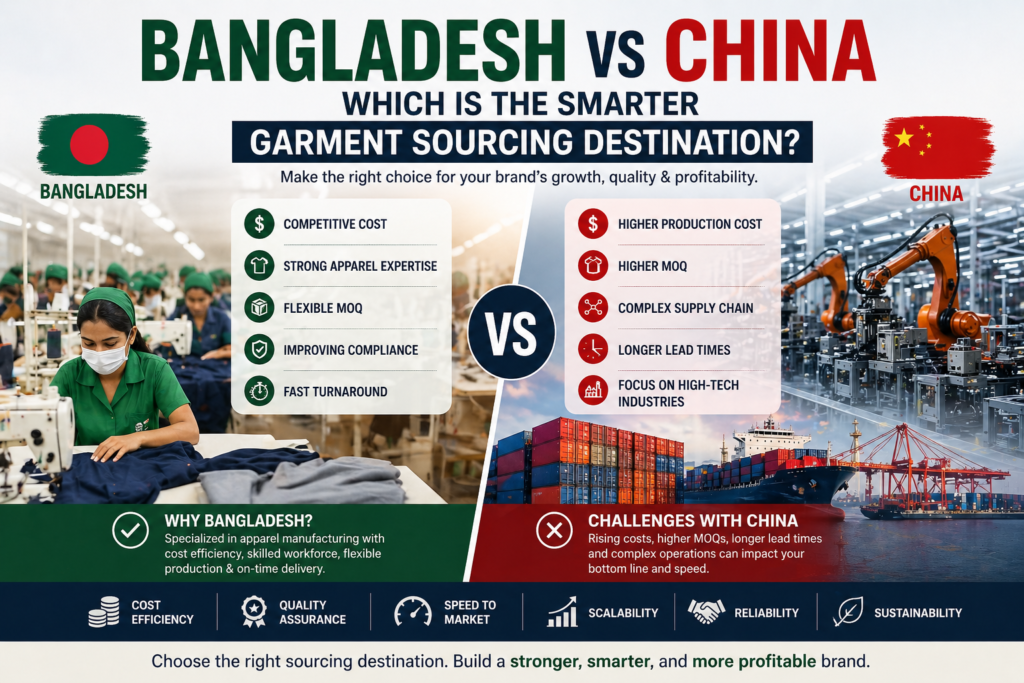
Bangladesh vs China: A Strategic Comparison
To simplify the decision, here’s how the two destinations compare:
China
- Strong in advanced manufacturing
- Higher production costs
- Suitable for complex, technical products
- Highly automated infrastructure
Bangladesh
- Cost-effective apparel production
- Specialized garment manufacturing
- Flexible MOQs
- Growing compliance and sustainability standards
- Strong sourcing ecosystem
For most fashion brands focused on apparel, Bangladesh offers a more balanced combination of cost, scale, and flexibility.
Final Thoughts: Choosing the Smarter Path
In 2026, sourcing is no longer just about finding a factory.
It is about building a supply chain that supports your brand’s long-term growth.
China remains an important player in global manufacturing. But for apparel-focused brands, especially in the UK, Bangladesh is increasingly becoming the smarter choice.
It offers:
- Competitive cost structures
- Scalable production capacity
- Improved quality and compliance
- Greater flexibility for evolving business needs
Most importantly, with the right sourcing partner, brands can turn Bangladesh into a reliable, long-term production base.
Ready to Rethink Your Sourcing Strategy?
If you are exploring Bangladesh as your next sourcing destination, Sara Sourcing can help you navigate the process with confidence.
From initial concept to final shipment, we provide structured, transparent, and reliable sourcing solutions tailored to your brand.